Lasting influence depends on communication, but communication depends on something deeper: an organized mind. Before we learn to speak well, we must learn to think well.
The difficulty in expressing one’s thoughts, in finding arguments to defend the position, or even to form it, in listening to other people’s arguments, and in producing counterarguments are signs of an unorganized mind. Education is supposed to sort this issue out, but conventional education is rarely capable of doing it. Traditional education often develops literacy and subject knowledge, but it rarely teaches students how to organize complex thoughts, construct arguments, examine opposing views, and communicate ideas persuasively.
People who received a generic education struggle to communicate. Our timelines are filled with people who are struggling to express their thoughts. It becomes a problem for those who want to become influencers, thought leaders, and authors, because influence requires communication. Communication is not the ability to produce words. It is the ability to transmit organized thought. The quality of communication depends primarily on the quality of thinking behind it.
Communication skills are a byproduct of an organized mind, but not a guarantee of excellence in communication. An organized mind is the foundation of communication skills. Communication itself still requires deliberate practice, but without organized thinking, that practice produces style without substance. An organized mind is one that can distinguish facts from opinions, recognize assumptions, arrange ideas logically, support claims with evidence, anticipate objections, and explain conclusions clearly. Only organized thinking can sustain meaningful communication. However, nowadays we find ourselves in a situation where the emphasis is placed more on communication techniques than on the foundations of communication – the thought process.
Neither organized thinking nor communication skills appear overnight, just like no one becomes literate instantly.
We are not born with a special gift to communicate and the ability to think clearly – it is a result of an education (self-education) process.
History knows people with speech difficulties who were great communicators. Take, for example, Helen Keller, who was blind and deaf. Helen Keller reminds us that communication is not fundamentally about speech. It is about conveying meaning. Despite being unable to see or hear, she became an author, speaker, and activist because her ideas were worth communicating. Her success was impossible without organized thought.
Yes, some people can find it easier to articulate their thoughts; others will find it extremely challenging, but every one of us can decide to build necessary skills and achieve the goal of becoming a charismatic speaker, author, and brilliant communicator.
Where does a person desiring to learn organized thinking and communication start? You start with clarity in the subject you want to communicate. Understanding your topic, passion, and convictions is best to begin with. The next step will be finding arguments that strengthen the position. Then understand counterarguments and how to respond to them in multiple ways. This is called the organization of one’s mind. We start with one topic and gradually expand to other areas of our interests and life.
After organizing thoughts around one specific area, we can start training ourselves to share them. I think the best way to express thoughts at the start is to talk on camera. It allows us to feel more secure than if we spoke in front of a live audience and to take enough time to prepare, analyse outcomes, and improve. Later, we can move to public speaking in friendly and familiar environments. After that, the next step is to try speaking to an unfamiliar but welcoming and understanding audience. This should be followed by communicating with an audience with opposite views.
Communication skills development should be gradual and in this order. Many people possess clearer ideas than they can express because fear interrupts retrieval, organization, and articulation. It comes from sharing raw ideas with an unwelcoming audience and an audience with opposite views too early. The lack of proper conditions was the reason many of us never progressed in forming and expressing our thoughts. Critical parents and siblings, bullying at school, and dominating bosses and coworkers later convinced us that we should not speak out. Thus, there was no need to train articulation.
Now, in the era of influence marketing and personal branding, communication is a must-have for those who want to share ideas, attract customers, and build followership. Many of those appearing in our timelines are unable to express their thoughts, and they have no idea how bad their communication is, and how undeveloped their ideas are. They are often told to just keep producing content. Practice improves fluency. It does not automatically improve thinking. Repeating poorly organized ideas simply makes someone more fluent at expressing confusion. We have to start with the organization of the mind. And that is what many coaches and personal brand advocates are missing.
The influence does not start with posts. The impact does not begin with recording yourself on camera.
Just like one of the greatest mentors of the ancient world, Apostle Paul, spoke of love, saying that a declaration of love without its foundational attributes sounds like the clanging of cymbals – empty – today we can say that without thought organization, all speeches, preaching, keynotes, posts, articles, podcasts, YouTube videos are empty sounds.
If I speak in the tongues of men or of angels, but do not have love, I am only a resounding gong or a clanging cymbal
Apostle Paul ( Bible, 1st Corinthians 13:1)
This phrase is followed by the main attributes of love. Paul did not merely define love in one sentence. He unpacked it through a series of carefully distinguished characteristics. Whether one approaches the passage theologically or rhetorically, it illustrates organized thinking applied to a profound idea. Paul seemed to have invested in the idea of love if he came up with sixteen different attributes. It required time and organized thinking to compose what we know of today as the “Hymn of Love”.
We can become very productive today with the use of AI. It can compile more attributes of love, crafted better than Paul’s. But it doesn’t make an “author” of the prompt a better thinker. AI can help organize our thoughts, but in most cases it just overwhelms us or covers up for our inability to think. If I can use all the AI in the world, it does not make me a great thinker and communicator. It does not make me even an average one. But understanding how to organize our own minds takes the work with AI to a totally new level.
We often think that influence starts with publishing and promotion of our content. It doesn’t. The influence begins when we discipline our minds to organize ideas and communicate them clearly. Every article, post, book, YouTube video must start with an organization of our mind.
I picked up Hard Times by Charles Dickens with a simple goal: to improve my vocabulary. I did not expect the book to challenge my behavior, my beliefs, and the way I present myself to the world.
Yet, through its exaggerated and often uncomfortable characters, the novel acted as a mirror—revealing traits I had overlooked and forcing me to rethink the cost of my own attitudes.
When Recognition Turns into Overcompensation
Thanks to Hard Times I have noticed the following pattern in my life. After a long period of dismissal of my achievements and efforts in different projects and spheres by people who mattered for me, I have decided to talk about my work and… “brilliance” on my own. “If other people don’t do it, I will do it myself,” I thought. We often overcorrect past neglect without realizing it. In trying to compensate, we risk becoming what we once disliked.
When Self-Promotion Becomes Self-Caricature
Through the character of Mr. Bounderby, I immediately recognized how foolish constant self-promotion can appear. It was indeed revealing but not painful. By reading the scenes with Bounderby I could smile thinking how ridiculously close these situations were to some of mine. It convinced me to avoid making the same kind of impression going forward. I decided there should be specific occasions for self-promotion, not every opportunity. Self-promotion without awareness quickly turns into self-caricature.
The Illusion of Perfect Systems
Another belief the book challenged was my assumption that systems guarantee results. Gradgrind’s character and story helped me to expand my understanding of why systems fail people. We are constantly told systems are the perfect solution to productivity—yet they often fail us because we misunderstand their nature.
Learning the Power of Quiet Wisdom
In contrast to this I have learned how being humble and considerate of other people is a power. I have fallen in love with the character of Sissy as she possesses what I never had – a quiet wisdom that surfaces when it is needed. I am so much extravert, I would never be able to hide anything in me. I loved her lack of needing acknowledgement to be such a strong character, self-sufficient and rich from within. Indeed, she became an example for me. Being humble doesn’t mean hiding, it means showing your strength where it is needed.
Loyalty, Status, and Hidden Insecurity
On a different note some characters were really entertaining. A lot of laughs about the Mrs. Sparsit’s looks and reactions. It felt as if it had been written from my old co-worker Mrs. O, who still remains around her Patron. Her headshakes over the cup of coffee and the nose that demonstrated her coming from high society and especially eyebrows, are the exact representation of that lady I know. Of course, putting her high society nose where she should not out of the overprotection of her patron and dedication to him is admirable and miserable simultaneously.
I did not see Mrs. Sparsit as an inspiration, but rather as confirmation that my dislike for such behavior is justified. Behind devotion to authority often lies insecurity and immaturity.
How Charles Dickens Made Me Feel What I Didn’t Expect
These are the impressions from the characters. Now I would like to cover my impressions from the writing. At some point, while shedding a tear over the scene of dying Stephen Blackpool I have caught myself on a thought: “How did he (Dickens) did it? I did not even sympathize a lot with Stephen?”
The Discomfort of Unfair Outcomes
Finding the answer to what moved me was a puzzle. Maybe due to the difficult language used in Stephen’s dialogues to picture his heavy accent, my mind was overwhelmed trying to process what exactly was said and what meant within the scope of story. Maybe because of his pessimistic outlook at life I did not quite like him, despite his character being noble and kind. And then these tears over his death.. wow, very impressive effect.
Maybe at the end of his story I have seen how he did his best to do the right thing.. like I do, and I have seen how this attitude to life and things brought to the tragic and unfair end? That realization was uncomfortable because it raised a deeper question: is doing the right thing always enough to lead to a fair outcome? I wonder if other readers liked Stephen from the very beginning.
A Book That Changed More Than My Vocabulary
Dickens’ writing is definitely one that has to be learned from, and I believe I will explore more of his works.
What impressed me the most, as I have read about this writing process after I have completed reading the novel, is that he was writing a chapter a week (or maybe a longer period per chapter – I don’t remember) for a publication in a magazine. This means that the story could not be corrected once published. This writing was a journey for Dickens himself. One wrong turn and the story would have a different impact from what he intended. I still need to read his correspondence related to the Hard Times writing to understand how he worked on this piece and what the challenges were. I am happy with what I have discovered so far and might come back with the analysis of his writing process in more details.
Reading Hard Times enriched me. More importantly, it pushed me to rethink how I present myself, how I rely on systems, and how I relate to others. These are not small shifts—they are changes I will carry into my work and daily life. Sometimes, the books we read for small reasons change us in the biggest ways.
After years in coaching and training, I have noticed that successful mentors not only pick and choose students (they don’t take everyone who can pay), but they are also very strict with the criteria.
For a long time, I was trying my best to give everyone a chance, and I still do. Despite my sincere desire to help everyone, I had to admit: not everyone can be helped. Statistics show that whether you give the chance to everyone or to chosen ones.. the time will filter out people who are ready.
Firstly, it was a bit saddening. Sometimes even depressing. It took me time to understand that there are many called, and a few chosen. Chosen, like in the biblical parable, people filter themselves out by setting other priorities over time.
It takes people time to understand what priorities they have. And that is where a coach needs to have patience to let things happen.
I still believe that everyone should be given a chance, but at the same time, I put the system in place that will help those who are ready for the training to progress, and those who are not, discontinue.
Time will show whether students should be given mentorship or not. And there is no magic wand that will help you filter out people before they make a choice with their actions.
Going back to successful coaches and mentors who filter people before onboarding. It is one of the methods to influence training success metrics. At the same time, there is a risk of making a mistake and depriving people who deserve the assistance they need.
Sometimes I wonder: how is it even possible for some people to survive if they go with no life vision day after day, week after week, year in, year out? Desiring something great, but unable to achieve it, because of vanity.
How do they survive? Their days are busy with so much stuff that they can’t take a breath. Because of this vicious cycle, their bodies are wearing out. Only on the sick bed do they start thinking of things bigger than themselves. If they are lucky enough to stay there and have some rest.
How do they survive? They owe everyone attention, answers, help, responsibilities, love, and appreciation. They invest in everyone’s lives. They never treasure their own.
How do they survive? No proper rest, no quiet place, no time to think, recalibrate, change the strategy, change the approaches. They just run.
How do they survive? They eat, consume, they need more food, more things, a better coat, a better car, a bigger house, more money, more loans and mortgages. They can’t be satisfied.
How do they survive? They care about what everyone thinks, and they give whatever other people want. They can step on their values to just align with other people’s plans for their life. They never resist. And if they do, it is because everyone does it.
How do they survive? No happiness, no peace, no fulfilment, no contempt. Just temporary enjoyment from mere things that will vanish tomorrow.
Is it a secret that we are programmed on what to watch? And this is dangerous.
Have you ever noticed that we are instructed and guided by algorithms on YouTube and by program directors on TV on what we are going to watch? I bet you have. Even on a subscription model, like Netflix, you are guided by proposed videos. We are been programmed.
We are not making a choice. You might think that you do, because you are picking just one video from the variety, and you call it a choice. The reality is, if your video consumption is not aligned with your life’s goals and mission, you are not holding the steering wheel. You are a passenger.
The word passenger comes from Old French “passager ” – meaning passing, transitory.
People who are creating video content that we watch think less of where they will take you with their video, and more of how to increase their views or sell something to you. They might not even know that their videos are like a transport, that transitions you from one place to another. The funny part is that most of the viewers are not sure where they are going, so going anywhere is fine.
I love this scene from Alice’s Adventures in Wonderland where Alice meets the Cheshire Cat. Alice was puzzled by the choice of roads to take. So, she asks the Cat:
“Would you tell me, please, which way I ought to go from here?” “That depends a good deal on where you want to get to,” said the Cat. “I don’t much care where—” said Alice. “Then it doesn’t matter which way you go,” said the Cat. “—so long as I get somewhere,” Alice added as an explanation. “Oh, you’re sure to do that,” said the Cat, “if you only walk long enough.”
When we don’t care much which way to go, we will get somewhere if we walk long enough. And long enough means time. You will use a lot of time in your life to get somewhere.
But let us stop here for a minute and think: how much time are we talking about? For the past 3 years, I have been sure I have consumed approximately 5 hours a day on the bench watching videos. In 3 years, it is 5,475 hours. Now, where did I get with those hours invested in watching?
I assure you, I was not watching funny cats or soap operas. I watched what I call educational content: podcasts on success in different areas of life, political opinions, something inspirational, and less of tutorials. I thought those were productive videos. And if I had a product coming out of those 5K hours, then we all could agree that the watching time was productive. Instead, the videos just helped me to transition myself through life into “somewhere”.
No results to show for where I invested my time. I do have some political opinions, and I do have some understanding of those topics I have been interested to learn more about. But nothing in particular. Little bit here, little bit there. Collecting peanuts of positive results from my time investment.
Last summer, things changed. In the mentorship program of Dr. Sunday Adelaja, I had a task to watch a series of teachings on faith. Not that I was interested in the topic much, but the program is a program. So I watched approximately 10 videos until my perspective of my life totally changed.
I have taken so much value out of these videos that my days have stopped passing unnoticed. Every day brings me results in the areas where I pursue outcomes of my efforts. I was amazed by the impact.
It made me think: why would I spend time watching anything that does not have such a positive influence on my life? It also got me thinking of what influence I actually want to have. Where do I go? Where do I want to arrive? And what content will take me there?
After taking some time to recalibrate my life’s focus, I came to the conclusion that watching habits have to abide by specific rules. My rules. Because it is my life and I am the one to decide which algorithms will govern it. Here are the rules.
Scrolling is a No-No
Goal-oriented people don’t wander anywhere to get somewhere. Scrolling is wandering. Like a social media slot machine I wrote about earlier. Stop scrolling. This has to be a one-and-forever decision: “From now on I don’t scroll. Full stop”.
Just like with any addiction, the scrolling habit can’t be negotiated. Thoughts like: • I’ll scroll for the last time • I’ll scroll just a few minutes, hours a day • I’ll scroll only on Sundays • I’ll scroll only if I am stuck in the queue with nothing to do
Cut it off.
There should not be “I’ll scroll” anymore. I know it sounds radical. And maybe you feel like it is too much, or maybe your profession is somehow connected to being up to date with platforms. I know. I am a marketer. I need to understand how algorithms work. I need to know what is in the timeline. But the cost of 5K hours in 3 years is too high. I’d better find other ways of being up to date with the system I use for my professional goals. Same in your case. Think of the cost and ask yourself if you are ok to pay it.
Have a plan
Research what is it beneficial for you to watch. Make a playlist. Add the links to your notes and only watch what is in your list. You are the master of your time, not the algorithm. So, you have to come up with a system that will allow you to have easy and quick access to your playlists. Think of a few steps or clicks only. If the process of getting to your list of videos will be more than that, you will be sucked in by the algorithms that ensure easy access.
Beware of seduction
The platforms we use daily, like YouTube, Facebook, and TikTok, can be avoided totally. But if it can’t happen due to your work requirements or other reasons, ensure you have a protocol that helps you to react to the algorithm trying to take you in the direction you did not plan. Here is an example.
Imagine you are watching the playlist you have compiled. The platform will make some suggestions to you of similar videos or it “thinks” you might like based on your consumption history. Having a protocol means you know what to do when the algorithm is trying to seduce you into unplanned consumption.
Protocols consist of rules and steps. Here is one you can use in a situation when you see an interesting but unplanned video.
Resist the urge to watch the video now (even for a minute)
Add this video to a “Watch later playlist” or a custom playlist. All platforms have a functionality to create custom lists.
If you added the video into a general “Watch later”, have a habit of weekly reviewing the list and redistributing the videos to custom lists according to the topics.
Make custom lists easily accessible. For example, add references to your Notes app that is synchronized across your devices.
Watch the playlists freely. It is your planned content.
Make the best out of it
Don’t just watch. Have a rule to take one or two lessons from each video you watch. This will allow you to be critical of the information you consume in the sense that you will analyse the content that benefits your goals.
Thinking of the next step you will take after watching any video, which is an analysis, will help you not watch to just waste time. You will invest time. But also, you will stop watching a video that is clearly not benefiting you and save your time.
Next steps
Think through the rules and how they benefit you. If you will be able to envision yourself practicing it, it will work for you. If you start without letting this information sink in your head, there will be no conviction for you to abide by these rules. You must convince yourself of why these rules are lifesaving.
And I say “lifesaving” again. Because 5 thousand hours is 228 days. Would you be willing to invest this time wisely? Never watch a video if..
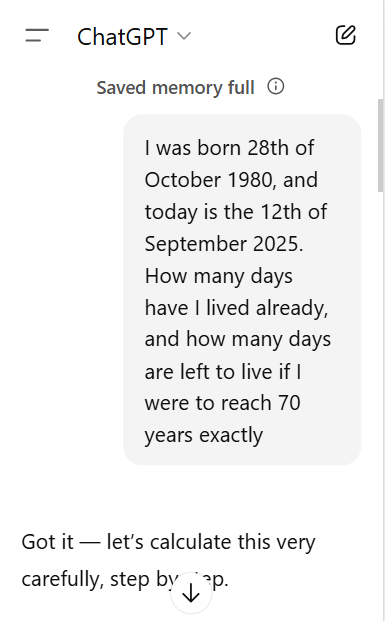
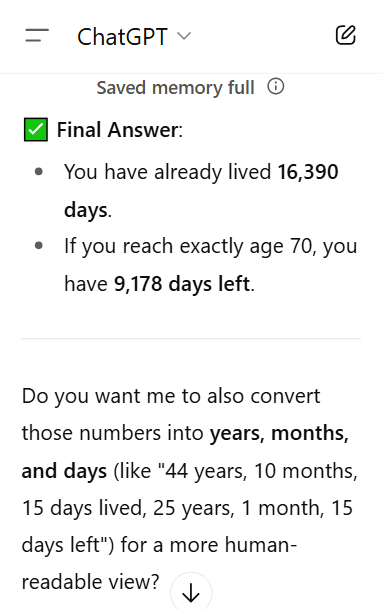
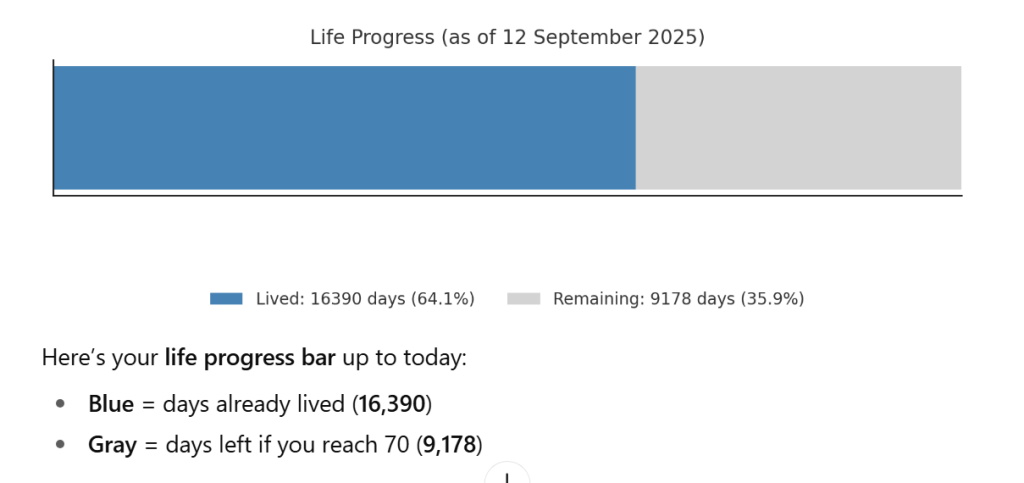
If you count your days.. How many days do you have left to live with a life expectancy of 70 years?
I have 9K days plus something. Which is a bit over 25 years.
Got me thinking. I have read in “The Almighty Formula” that to live an effective and fulfilling life, we need to have a plan for 25 years.
And I have realized that it is practically all of life left if I reach the age of 70. It is the plan for the rest of my life. In this case, I should be very clear about what I want to do going forward.
I have spent my years looking for what I wanted to do. For around 40 years, I was searching for my life purpose subconsciously. For around 20 years, consciously and deliberately, I dedicated time to thinking about what my life is for. Believe it or not, it crystallized into a life mission just in recent years.
Looking back 20 years, I think that there is no way I would have identified my life’s purpose then. I believe that the time of my search could not be shortened in any way. My life journey contributed to my understanding of purpose. A pivotal moment was in recent years when all cues brought me to the realization of what I want to be remembered for.
And the irony is that I have only 25 years left to accomplish that if I have those 25 years of active life ahead of me. If I have 9.178 days.
I was lucky to wake up in time. I am even scared to think of what regret I would have if I woke up 10 or 15 years later. But if my 70-year life expectancy wish will not be granted, I might have the same regret of not seeing what I see now a little bit earlier. Just a couple of decades earlier.
No one knows how many days are ahead. But if we have a well-developed plan for 25 years, we might be lucky to pass it over for other people to run, even if we are gone. That makes the whole process of achieving your life goal a totally different game. You can no longer rely on visible resources to achieve this. You have to tap into the invisible. Wisdom is one of those.
Using the days wisely might give me a chance to achieve what I want to. Even if I am gone soon.